


Photography by Dinendra Haria

10 min read5 hr
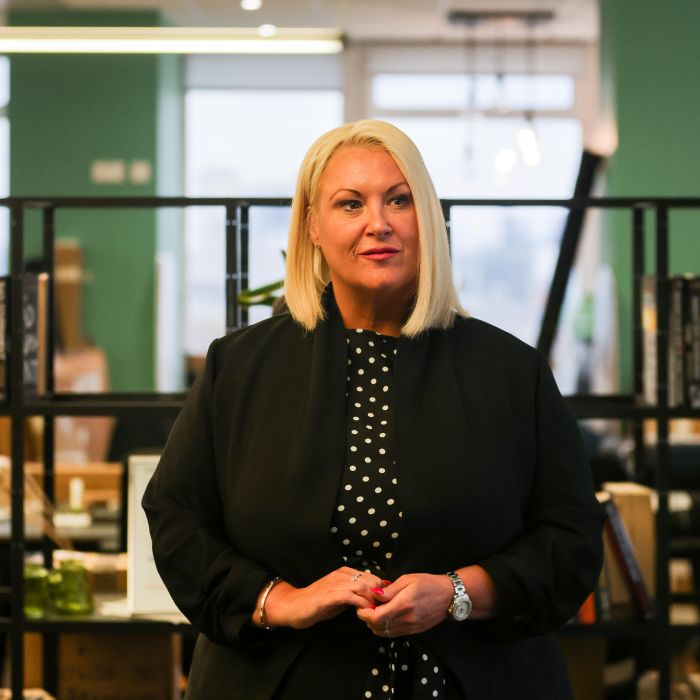
Usdaw general secretary Joanne Thomas talks to Noah Vickers about Poundland, John Healey’s ‘tinkering round the edges’ Budget and why ministers must not water down the Employment Rights Act.
Joanne Thomas learned some hard lessons early. Pregnant at 17, she was forced to leave her factory job because she couldn’t survive on the maternity pay on offer.
“I really became politicised when I had my child at a very young age,” Usdaw’s general secretary tells The House. “I was in a situation where more things mattered to me like what my contract looked like, how was I going to get on the housing ladder – just my income in general because I had another mouth to feed.”
Thomas left her job at a sewing factory in order to have her baby. It was in her next job, at the wholesaler Makro, where she first became involved in the trade union movement.
“I became a shop steward at Makro because I was a young person in a department full of young people and we tended to get paid less. We got the worst shifts because we were the youngest on the department, which didn’t matter to some of my colleagues, but it mattered to me because I had a child.”
When Chancellor John Healey recently refused to guarantee that Labour will fulfil its manifesto pledge to give 18-20 year-olds the same minimum wage as other adults before the next election, Thomas felt keenly aware of what would mean.
“We are absolutely adamant that we want Labour to fulfil their manifesto commitment. That is the whole point of manifesto commitments,” she says. “They are discriminatory age bands, there’s no two ways about it.”
While the minimum wage for anyone 21 or over is £12.71 per hour, those aged 18-20 are still only entitled to £10.85.
“I’m somebody that lived and breathed it myself,” says Thomas, casting her mind back to her days as a teenage single mother.
“I was paid less, but I still had a house, I still had my rent, and then when I bought [a home], a mortgage to pay. I still had to put food on the table, yet to get paid less… it was just absolutely ridiculous.”
The issue, she says, strikes at the heart of the government’s struggle to tackle the crisis of young people not in employment, education or training (NEETs). For someone taking their first steps in today’s labour market, whether they can expect to be paid enough to live comfortably makes a major difference.
“Do people feel like work is giving them access to a better life?” she asks. “If it’s not, the answer is not to reduce the pay and the terms and conditions from when you’re first starting with the company.
“The answer has to be about giving good jobs, about giving jobs with decent pay, decent terms and conditions, so it’s attractive enough to say ‘Do you know what? I’m going to apply for that job.’”
Thomas, 47, grew up in Shiney Row, a former mining village near Sunderland. Her childhood was a happy one, with her mother working as a domiciliary care worker for the local authority and her father a social worker who later became a taxi driver.
At 21, she became the union’s youngest area organiser in its history, tasked with representing more than 4,500 members. Stints on Labour’s National Executive Committee and as president of the Yorkshire and Humber TUC followed, before her unopposed election last year as Usdaw’s first female general secretary.
Usdaw, which represents workers in retail and distribution, is generally viewed as sitting on Labour’s right flank, but Thomas is reluctant to put a label on what Labour tradition she personally identifies with, saying she’s “not a big fan of pigeonhole politics”.
A wild swimmer in her spare time, she also serves as chair of the Trade Union and Labour Organisation (Tulo), the umbrella grouping of 11 unions affiliated with Labour.
In May this year, Tulo played what may have been an overlooked role in Sir Keir Starmer’s decision to step down as prime minister, when the group issued a scathing joint statement following the local elections.
The unions collectively acknowledged it was “clear” that Starmer would not lead Labour into the next election and “at some stage a plan will have to be put in place for the election of a new leader”.
Thomas says a change of leadership so early in the life of this government “wasn’t what anybody wanted”, but that “the writing on the wall” was spelling defeat for the party at the next election.
“It was difficult, because we all recognised the situation,” she reflects. “I think ultimately there was a recognition from Keir himself and there was a solution in Andy Burnham.”
The first Budget of Burnham’s premiership, however, has left Thomas underwhelmed. Particularly disappointing, she says, was the decision to keep income tax thresholds frozen.
“We’re now seeing some of the jobs that have never been paying 40 per cent tax moving into that bracket. I would like to see something like that, that could really put the money back into the pockets of workers.”
The increase in the bank corporation tax surcharge gave greater cause for celebration.
“I hope that the Chancellor goes further, at every opportunity he can, to hike up the tax on the banks, because they absolutely can afford it – they know they can afford it,” she says.
“If Labour’s talking about delivering on some of the bigger things like social care for all and delivering a Budget that works for workers, then obviously the money has to come from somewhere. I’d always argue that pulling on the levers of wealth is, if nothing else, the starting point on that.”
While Burnham has vowed to draw a line under “40 years of neoliberalism”, Thomas makes no bones over her disappointment in the Budget’s relatively modest changes.
“I think it could have gone further. From what I hear, there’s a desire to do that, but I don’t think you can expect people to wait too long. Ultimately, at the end of the day, people have been feeling repressed, particularly from a financial point of view, for decades now. The cost of living crisis just hasn’t eased up for such a long time.
“Do people feel like work is giving them access to a better life?”
“I don’t think people want to hear about jam for tomorrow, they need something for today that will give them the reprieve and start to make them feel even just a little bit better off. So I think it was tinkering around the edges, but I would have liked to have seen it being bolder.”
Away from the Budget, Thomas has been kept busy over recent days by the situation facing Poundland and its 12,000 employees at risk of redundancy.
“If this situation was happening in the likes of steel or other industry there would be an uproar about it,” she says, adding that there needs to be a national change of narrative to recognise retail’s importance to the economy.
“Retailers are the largest private sector employers in the UK. Through the pandemic, they were seen as like the fourth emergency service, and yet when we have situations like this, there doesn’t seem to be the gravitas that is shown to industry.”
Legislation should be passed, she argues, to place greater controls on venture capitalists, to ensure the same thing cannot happen in future to other British businesses.
“It is unacceptable for a company to put this many British jobs at risk, because we have overseas investors that want to line the pockets of their shareholders – even when the business is doing well – and they don’t want to sell.”
More broadly across the sector, the general secretary is concerned about abuse and harassment towards shop staff, which continues to be reported at higher levels than before Covid.
Recent years have seen TikTok pranksters increasingly filming in shops and supermarkets. Attempts at humiliating staff and customers are recorded – often using inconspicuous smart-glasses – and uploaded onto social media for all to see.
“We are having a lot of our members that are being filmed without their knowledge, without their consent. This could be putting people into really dangerous situations, particularly if they’ve moved somewhere to get away from domestic violence or something like that,” Thomas points out.
“But it’s also not good because a lot of the content is around mocking them without them knowing and they’ll all of a sudden see this or hear this from friends or family…
“That really does impact people’s mental health – not feeling safe at work, feeling vulnerable, being paranoid if you see somebody with glasses on that might look slightly different,” she adds.
“The ramifications that this has on the actual worker are really detrimental, so again, you wouldn’t think that you’d have to put legislation in for things like this, but we should.”
In April, Usdaw’s annual delegates meeting called for a ban on all videoing in shops by the general public, unless direct consent has been given, and earlier this month, safeguarding minister Satvir Kaur said the government is “already looking into options to restrict smart-glasses in certain settings and restricting the sale to certain users”.
Thomas has also been vocal in her support for the rights of Usdaw’s trans and non-binary members, arguing that the Equality Act should be reopened to change how it defines gender in light of last year’s Supreme Court ruling.
“I would like to see the legislation changed again, to go back to where it was,” she says, referring to the ruling’s impact on how the statute is now legally interpreted.
“I think we’ve gone back as a society, in general, because of this legislative change. I hear some really awful, sad stories from some of the LGBT+ community that we represent, and I want to be supportive of them at every opportunity that I can.”
Of the guidance issued by the Equality and Human Rights Commission, she says: “I don’t think it makes sense and I think it is unmanageable. We’ve seen, on the back of this, a hate crime increase which is just really sad… I don’t agree with the outcome of the Supreme Court [case]. I would like to see it reversed.”
Barring an early election, there is still two and a half years of this Parliament to go. Thomas is clear that, in that time, there can be no rowing back on the full implementation of the Employment Rights Act.
Usdaw is campaigning to ensure ministers do not dilute the legislation’s provisions to end “one-sided flexibility”, by ensuring all workers have a contract which reflects the hours they actually work.
Currently, employees may have a contract which only guarantees them a small number of hours, but in reality they may regularly be asked to ‘flex up’ significantly from that allocation by working extra shifts.
The result is workers unable to properly evidence their income when applying for a mortgage or loan, damaging their prospects of getting on the housing ladder.
The government included a provision for guaranteed hours in the legislation last year, but has carried out a consultation – which closed in August – before implementing it. Thomas is adamant that the policy must not be watered down in the face of lobbying from employers.
“There’ll be a huge amount of pressure from the business [community], so what I’m saying to Johnny Reynolds and to the PM and pretty much any politician that will listen is that this has to be a priority.
“This actually will help the Treasury in turn as well, because ultimately if people can’t get full-time jobs or decent jobs, then they’re going to be on the likes of universal credit or they’re going to be looking at other ways of how to supplement their salary.
“That isn’t good for the Treasury and it’s not good for the individual. So it’s a real, big gamechanger – getting the Employment Rights Act delivered – for lots of different reasons, that’s just one of them really.
“Again, it goes back to having a government that delivers, at the heart of everything, on the cost of living – that really is a measure of how they can do that.”